


Why RAM Prices Are Exploding in 2026 – Causes and Impact
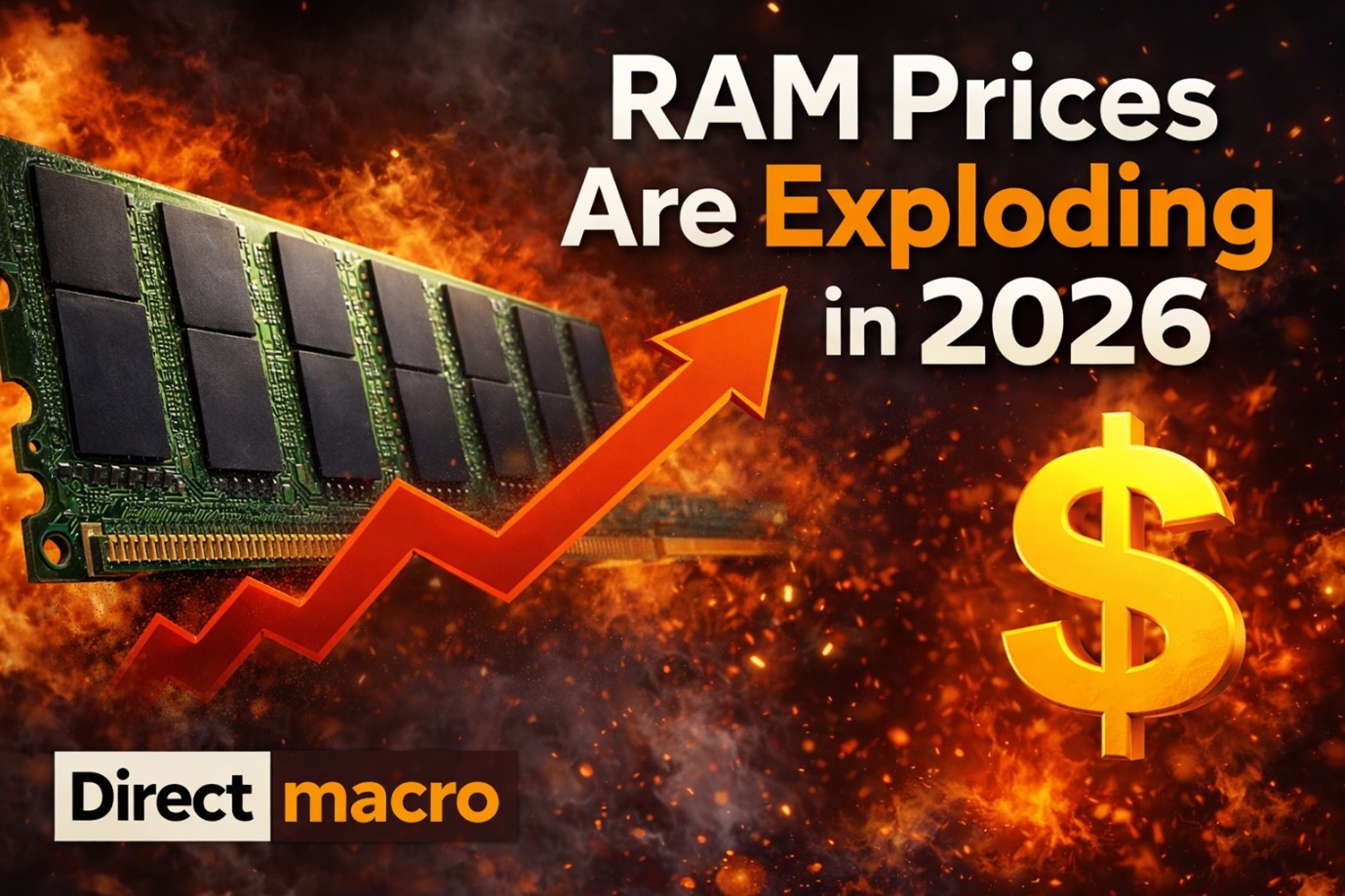
In 2026, the technology world is facing big changes in how hardware procurement is bought. Both businesses and tech fans are especially worried about the sharp rise in RAM prices. At Direct Macro, we work to keep our clients updated about these market changes so they can make smart buying decisions.
In this blog, we look at the main reasons why RAM prices have hit record highs and what this means for both businesses and everyday consumer sectors.
The Current RAM Price Crisis Explained
Rising RAM prices are changing the structure of the semiconductor industry. Memory prices have jumped sharply, with DRAM products going up by as much as 110% in just single quarter.
A 16GB DDR5 chip that was $6.84 in September 2025 now costs more than $27, which is four times higher. After adding assembly and other parts, one 16GB module now costs manufacturers over $225 before profit margins.
DDR4 RAM prices have stayed mostly steady, but new DDR5 kits have gotten much more expensive. Contract prices for DDR5 modules have almost doubled each month, and spot market prices are even more unpredictable.
Why Did RAM Get So Expensive? The AI Demand Explosion
RAM prices are rising mainly because demand for artificial intelligence infrastructure is growing quickly. Major technology companies are competing intensely to advance their AI capabilities.
Major AI Players Driving Demand
- Microsoft: is spending billions on AI data centers that need large amounts of HBM to support Copilot and Azure AI services around the world.
- Google: is growing its Gemini AI infrastructure, which needs a huge amount of memory to train models and handle billions of daily inference requests worldwide.
- Meta is creating private cloud systems to power AI features on Facebook, Instagram, and WhatsApp for billions of users around the world.
- Amazon is expanding AWS Bedrock and other AI services, which is driving up memory needs in its growing network of data centers worldwide.
- OpenAI continues expanding ChatGPT infrastructure, requiring continuous capacity increases to serve the rapidly growing user base and new features.
The HBM Problem:
High Bandwidth Memory (HBM) plays a key role in AI accelerators and GPUs. Making HBM uses about three times more wafer capacity per gigabyte than standard DRAM. When wafers are used for HBM in NVIDIA GPUs, they are not available for making consumer RAM or enterprise DDR5 modules.
By 2026, AI applications are expected to use almost 20% of the world’s DRAM wafer capacity. This means about 3 exabytes of cloud memory will be needed for core inference tasks, private infrastructure, and the growing AI market in China.
The Oligopoly Controlling Your RAM Prices
To understand why RAM prices are rising, it’s important to look at who controls the market. Three companies dominate global memory production:
- Samsung Electronics is the top producer of DRAM worldwide. With large facilities in South Korea, the company is shifting its focus to higher-margin products, which means less RAM is available for regular consumers.
- SK Hynix focuses on HBM and other high-end memory. Its HBM, DRAM, and NAND supplies are already sold out through 2026, so there is no extra capacity for consumer products.
- Micron Technology is the main US memory maker. It has left the consumer market, ending its Crucial brand to focus only on business and AI clients.
Together, these three companies control about 95% of the world’s DRAM production. Samsung’s co-CEO said, “in 2026, there’s going to be issues around semiconductor supplies, and it’s going to affect everyone.
Production Capacity Can’t Keep Up with Demand
Building semiconductor fabrication plants takes a lot of money and several years, so the shortage cannot be fixed quickly.
- Samsung’s Expansion
Samsung plans to increase its capacity by 50% in 2026. However, the P5 facility in Pyeongtaek will not be ready until 2028, and the company is investing a lot in EUV lithography equipment.
- SK Hynix’s Investment
SK Hynix is quadrupling its infrastructure investment to focus on HBM production. The M15X facility will not start producing until mid-2027, which means there will still be important supply gaps in the near future.
- Micron’s Long-Term Strategy
Micron has committed $200 billion to manufacturing in Idaho, New York, and Virginia. However, the New York facilities will not start producing until 2030, so there will be no immediate relief.
Industry analysts expect DRAM supply growth at only 16% year-over-year in 2026, with NAND at 17%. Meanwhile, demand growth is projected at 35%. When demand outstrips supply by such margins, prices must rise until demand destruction occurs.
Memory Prices News: Impact Across the Tech Industry
The surge in RAM prices affects more than just people building gaming PCs. It has a ripple effect across the whole technology industry.
PC Manufacturers Face Cost Pressures
- Dell, HP, Lenovo, Acer, and ASUS have all told customers to expect 15-20% price hikes on new computers starting in early 2026.
- Dell’s Chief Operating Officer said the company had “never witnessed costs escalating at the current pace” in all their years in business.
- Morgan Stanley downgraded Dell’s stock, pointing to the company’s high exposure to rising server memory costs that are impacting profits margins on enterprise products.
- Manufacturers are seeing shortages not only in DRAM, but also in hard drives and NAND flash memory, leading to several supply problems at once.
Smartphone Market Disruption
- Chinese brands like Xiaomi, Oppo, Vivo, and Transsion are lowering their 2026 shipment targets because rising memory costs are cutting into their profits.
- Manufacturers are stuck between raising prices and lowering specifications, so customers end up paying more for less than they did in previous years.
- Budget smartphones are going back to 4GB RAM, which was once seen as outdated. This is a step back in both features and user experience.
- MicroSD card slots making surprising comebacks as manufacturers seek alternatives to expensive onboard storage, reversing years of design trend toward sealed devices
Even Hobbyist Hardware Affected
- Raspberry Pi raised prices several times after memory component costs more than doubled in just one quarter, surprising the maker community.
- All Raspberry Pi 4 and 5 models with 2GB or more memory now cost more, which affects educational programs and hobbyist projects around the world.
- Only the 1GB products remain protected from price hikes, and the company has enough older products in stock to protect them from price swings for a few years.
Consumer Impact: Gaming and Content Creation Costs Soar
A 64GB DDR5 kit now costs more than a PlayStation 5 for most buyers. Enthusiasts say prices are rising fast each week, and popular options often sell out within hours.
- PC Builders
Building a gaming PC is now much pricier, with memory making up 20-30% of the total cost instead of the usual 10-15%. Many people are putting off their builds, hoping prices will return to normal, though that may take years.
- Content Creators
Video editors who need lots of memory for 4K or 8K projects are seeing their costs go up sharply. People working in 3D rendering or music production with tools like Blender or Maya are also facing the effects.
- Upgrade Cycles Disrupted
Many users are putting off upgrades from 16GB to 32GB or 64GB for now. This slows down demand for CPUs, GPUs, and motherboards. As a result, second-hand markets are busier and prices there are also rising.
Enterprise and Data Center Challenges
Companies are dealing with procurement challenges that are unlike those seen in the past. While semiconductor shortages used to be resolved in 12 to 18 months, demand is now growing faster than production can keep up.
Large cloud providers such as AWS, Azure, and Google Cloud ensure their supply by making long-term deals, reserving capacity, and investing directly in manufacturing. These strategies give them priority access and lower prices, while smaller companies struggle to get what they need, even if they are willing to pay more.
Google, Amazon, Microsoft, and Meta have made open-ended orders with suppliers, agreeing to take as much supply as possible no matter the price. This approach pushes out smaller companies and creates a two-tier market, where having a close relationship with manufacturers matters more than how much you order.
Market Volatility and Spot Pricing Chaos
Random access memory prices are unusually volatile because of spot market dynamics. Large single orders, changing contract prices, currency shifts, and inventory levels can cause prices to change every week or even every day.
The spot market is now chaotic worldwide. In Tokyo’s Akihabara, retailers limit how much customers can buy to stop hoarding, and DDR5 module prices have doubled overnight. In China, a box of 100 server-grade DDR5 modules can cost as much as property in Shanghai. In Taiwan, distributors bundle DRAM with motherboards to manage supply.
This situation makes IT procurement much harder. Memory, once a predictable part, is now a major source of cost uncertainty. Companies need to add bigger price buffers and plan for different market scenarios.
When Will RAM Prices Come Down?
Industry experts disagree on when the market will return to normal, showing there is still uncertainty about how AI demand will change.
- Optimistic Projections
Some analysts think the situation could improve by late 2026 as new production lines start operating. As DRAM processes mature, yields should get better, and expansions by SK Hynix, Samsung, and Micron may help too.
- Pessimistic Forecasts
Some experts are more cautious and say it could take years for new capacity to affect the market, so prices may stay high through 2027 and 2028. Micron executives expect shortages “until 2028, or until AI demand fades.” Team Group also predicts shortages will last into late 2027 and possibly longer.
- Key Variables
The timeline depends on whether AI demand is a lasting change or just a temporary surge. If generative AI keeps growing quickly, memory demand could stay higher than supply at past price levels. But if AI investment slows down or technology becomes more efficient, the market might balance out sooner.
Strategic Responses for Organizations and Individuals
Organizations and individuals need to find ways to adapt to changing conditions and keep costs under control.
- IT Procurement Best Practices: Active market monitoring with teams checks prices every week instead of just once a year. Use flexible sourcing so you can switch between suppliers or memory types as needed. When possible, expanding DDR4 infrastructure might save more money than moving to DDR5.
- Infrastructure Planning: Start with basic configurations now and add extra capacity later if needed. For virtualization, databases, and AI, plan to increase capacity in steps. Cloud solutions that let you scale up or down can help you avoid big upfront costs.
- Alternative Strategies: Using tiered storage can lower the need for expensive SSDs by 35-65%, which may cut capital costs by 40-70%. Compression and better data structures reduce memory requirements. Containerization and smarter resource allocation help you get more out of your current infrastructure.
Direct Macro: Strategic Sourcing in a Volatile Market
At Direct Macro, we know that RAM prices play a big role in your budget. Right now, with prices rising quickly, just-in-time buying is no longer a practical option.
Our Recommendations for 2026
- Secure Inventory Early: Since prices may go up another 20% by Q2, buying your RAM in bulk from Direct macro store now can protect you from higher costs later.
- Evaluate DDR4 vs. DDR5: DDR5 is becoming standard, but good DDR4 kits are still a smart choice for legacy enterprise systems.
- Monitor Spot Markets: Prices are changing every week. Check our updates for the latest news on memory prices.
Final Thoughts
The sharp rise in RAM prices in 2026 marks a major shift in the semiconductor industry. This change is driven by the AI boom, which has created an unusually high demand for specialized memory.
Consumers will see higher prices for computers, smartphones, and other electronics. Businesses now need to focus more on how they buy memory. For the industry, this is a shift from treating memory as a basic commodity to seeing it as a product with lasting higher prices.
To understand why RAM prices are going up, it’s important to see that this is not just about supply and demand. The tech industry is shifting toward AI, and this change is showing up in key parts like memory. As data centers use more of the world’s memory supply, both consumers and businesses will have to adjust to a future where memory remains in short supply.
For more assistance, contact us at (855) 483-7810 or visit our website for bulk orders at affordable prices.
Frequently Asked Questions
Why are RAM prices so high?
RAM prices are high because demand is much greater than supply. Most manufacturing capacity is going to AI data centers, so producers are focusing on high-margin AI memory instead of consumer products.
How to improve RAM?
To get better RAM performance, use dual-channel mode, turn on XMP or EXPO profiles in your BIOS, and close background apps that use a lot of memory.
When will the price of RAM go down?
RAM prices will likely stay high through 2026. Prices may only start to drop in late 2027, when new factories open and demand from AI data centers levels off.
Why is the price of RAM going up for older DDR4 modules?
Manufacturers are moving to DDR5 and HBM, so they are stopping DDR4 production. It means there is less DDR4 available, but demand for older system repairs is still steady.
Is it better to buy RAM now or wait?
Current data shows that RAM prices are rising because of ongoing shortages. Waiting could be risky, so it is usually better to buy now before prices go up again. Visit the Direct macro store for affordable RAM storage bulk purchase.
Categories


tags

Expert team support
We accept POs from fortune 1000 companies, government agencies, defense, schools and hospitals.
Do you need advice on buying or selling hardware? Fill out the form and we will return.

Sales & Support
(855) 483-7810
We respond within 48 hours on all weekdays
Opening hours
Monday to thursday: 08.30-16.30
Friday: 08.30-15.30



