


9900X3D vs 9800X3D: Which AMD CPU Is Best for Gaming?
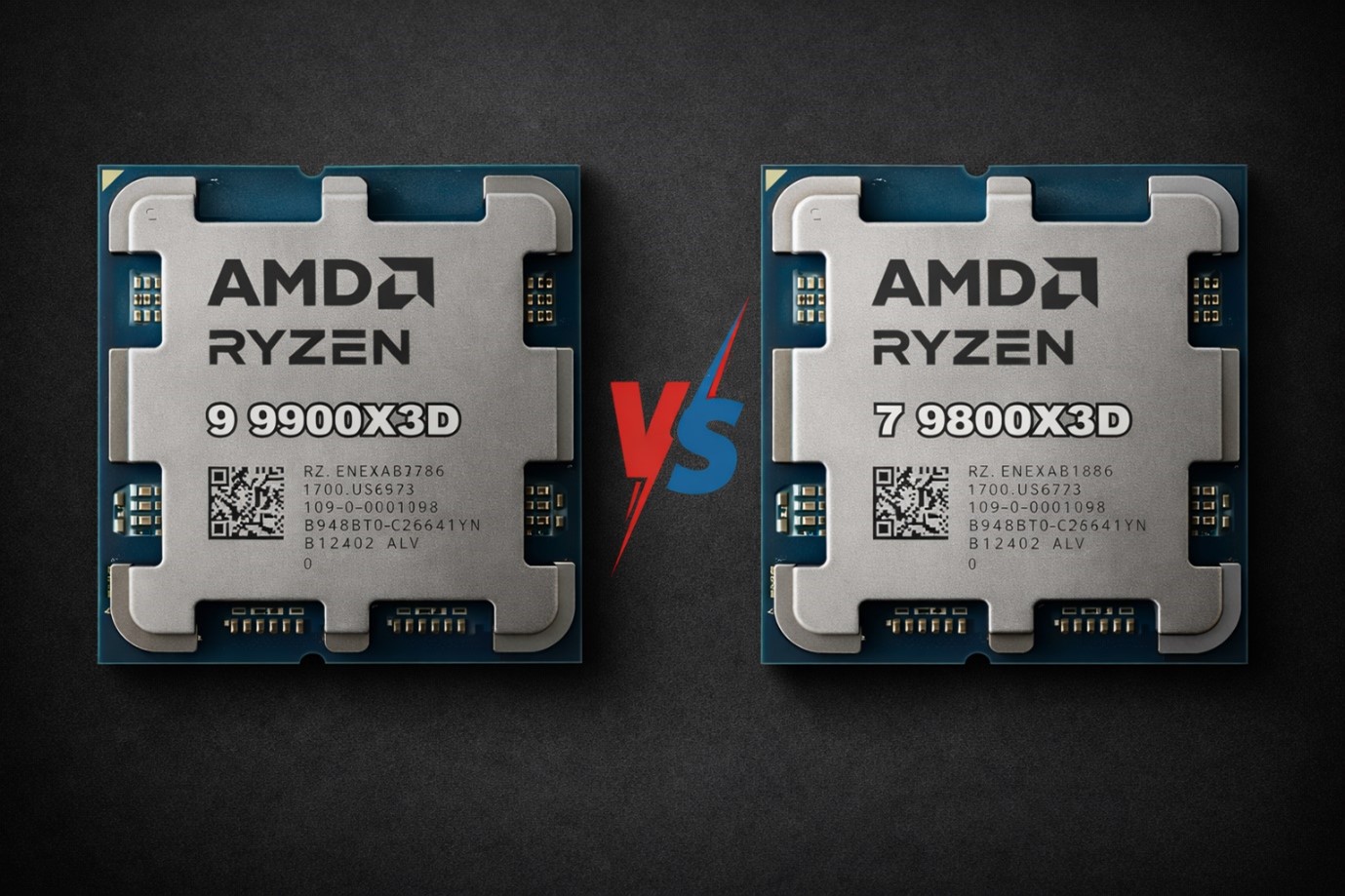
If you want to build a top-tier gaming PC in 2026, you should look at the ryzen 9900X3D vs ryzen 9800X3D. Picking between these two will help you get the best CPU for your needs. Both are part of AMD’s Ryzen X3D lineup. Both processors are made for gamers and powered by 3D V-Cache tech.
Some people get confused and think these CPUs are from Intel, but that’s not true. Both the Ryzen 9 9900X3D and Ryzen 7 9800X3D are made by AMD, not Intel.
In this guide, we will compare the Ryzen 9 9900X3D and Ryzen 7 9800X3D. We will check out their gaming power, specifications, and value to help you pick the right one.
Why AMD X3D Technology Matters for Gamers?
It is important to grasp the significance of 3D V- Cache technology to understand the core logic of the amd ryzen 9 9900x3d vs ryzen 7 9800x3d processors. This incredible innovation allows AMD to load L3 cache vertically on the processor die that provide the core with instant access to huge amount of data that would be stuck in the slower RAM system.
- Vertical Cache Stacking Efficiency: AMD drastically increases the amount of high-speed memory available to the processor by stacking 64MB of additional L3 cache directly on top of the core complex die. It is the main driver behind the massive frame rate gains seen in advance games.
- Drastic Latency Reduction for Gamers: Having a larger cache allows the CPU to store game instructions physically closer to the processing cores. It helps to reduces the transfer time for data and results in significantly higher minimum frame rates and a much smoother overall gaming experience.
- Perfecting 1% Lows and Stability: The Ryzen 9000 X3D series is famous for stabilizing frame times. Its extra cache ensures that your game would not interrupt due to the micro-stutters during chaotic, CPU-heavy scenes like explosions or large-scale battles. These things are common in standard processors.
Detailed Analysis of Ryzen 9 9900X3D vs Ryzen 7 9800X3D
The comparison between ryzen 9900x3d vs 9800x3d showcases a fundamental difference between these chips. While one focuses on a streamlined, single-chiplet design for ultra-low latency and the other provides a multi-chiplet powerhouse capable of handling professional workloads alongside high-end gaming. Let find out how these chips are built to handle data.
1. Core Specifications
Here are the key specifications of AMD ryzen 9 9900x3d vs 7 9800x3d to understand which processor is good fit for your system.
| Feature | Ryzen 9 9900X3D | Ryzen 7 9800X3D |
| Cores / Threads | 12 Cores / 24 Threads | 8 Cores / 16 Threads |
| Chiplet Design | Dual-CCD (6+6) | Single-CCD (8+0) |
| Base Clock | 4.4 GHz | 4.7 GHz |
| Max Boost Clock | Up to 5.5 GHz | Up to 5.2 GHz |
| L3 Cache | 128 MB | 96 MB |
| TDP (Power) | 120W | 120W |
| Architecture | Zen 5 | Zen 5 |
| Socket | AM5 | AM5 |
| Best Use Case | Work + Gaming Hybrid | Pure Gaming Excellence |
2. Why Choose AMD Ryzen 7 9800X3D?
If you want a high-performance gaming setup, the Ryzen 7 9800X3D is a strong option. It’s efficient and fast, making it a favorite for competitive esports players and anyone aiming for top performance at 1080p or 1440p.
Reasons to Buy
- The World’s Fastest Gaming CPU: This chip delivers top frame rates in competitive games, so your high-refresh-rate monitor (240Hz or 360Hz) can perform at its best without the CPU slowing it down.
- Remarkable Thermal Efficiency: With 8 cores on a single chiplet, this processor runs much cooler than the 12-core version. You can use it safely with a quality air cooler or a regular liquid cooling system.
- Better Value for Money: It gives you the best “FPS per dollar” among high-end CPUs, so you can save enough to upgrade your graphics card from an RTX 4070 to an RTX 4080 for better visuals.
Reasons to Avoid
- Limited Workstation Potential: While it’s great for gaming, the 8-core limit means exporting 4K videos or rendering complex 3D scenes will take longer than with AMD’s higher-core models.
- Less Headroom for Heavy Multitasking: If you want to run editing software, several browser windows, and Discord while gaming, you might reach this chip’s multitasking limits sooner than expected.
3. Why Choose AMD Ryzen 9 9900X3D?
If you’re deciding between the Ryzen 9 9900X3D vs Ryzen 7 9800X3D, think about your professional needs. The 12-core ryzen 9 9900X3D is a hybrid powerhouse for content creators who want a workstation during the day and a high-end gaming PC at night, offering the best of both worlds.
Reasons to Buy
- Elite Professional Performance: With 12 cores and 24 threads, this CPU handles multi-threaded tasks with ease. It’s perfect for video editors, software developers, and 3D animators who need fast render times and a responsive system.
- Superior Single-PC Streaming: The extra cores let you assign some to your streaming software (like OBS) and keep the V-Cache cores for your game. This way, you get a smooth stream without lowering your in-game frame rates.
- Massive L3 Cache for Productivity: V-Cache is mainly for gaming, but some professional apps and data-heavy simulations also benefit from the large L3 cache. This gives you an edge in specialized software that standard CPUs can’t match.
Reasons to Avoid
- Higher Total Build Cost: If you pick this processor, you’ll also need a premium 360mm AIO liquid cooler and a high-wattage power supply. These extras can add hundreds of dollars to your build.
- Occasional Gaming Latency: Since its cores are split into two chiplets, this CPU can sometimes perform a bit worse than the less expensive 9800X3D in games that are sensitive to memory latency and core communication.
9900X3D vs 9800X3D: Which One is Best for Gaming Performance?
Hardware enthusiasts understands that quantity is not always mean better when analyzing the results about 9900x3d vs 9800x3d gaming processors. Because they known that gaming engined are sensitive to memory latency. Compact and unified designed processors always deliver high frames per second as compared to a split architecture chip with a higher core count.
- The Single-CCD Latency Advantage: Since all 8 cores on the 9800X3D are contained within one chiplet, they all have equal and instantaneous access to the 3D V-Cache, which makes it the fastest pure gaming CPU currently available on the market.
- Cross-Chiplet Data Travel: In the 12-core model, if a game needs to move data from a core in one chiplet to a core in the other, it incurs a tiny latency penalty that can actually result in slightly lower FPS compared to the 8-core model.
- Console-Optimized Gaming Engines: Most modern games are developed for 8-core consoles, which means the 9800X3D matches the game’s logic perfectly, while the extra 4 cores on the 9900X3D often remain idle and provide no real benefit during active gameplay.
Power, Efficiency, and Thermal Management
Choosing between the AMD 9900X3D and 9800X3D also affects your system’s heat and your room’s temperature during long sessions. High-performance chips need good cooling to keep them from slowing down when temperatures rise during heavy use.
- Cooling Requirements for Success: The Ryzen 7 9800X3D works well with a high-end air cooler, but the Ryzen 9 9900X3D really needs a strong 360mm or 420mm AIO liquid cooler to keep its boost speeds up.
- Electricity Consumption and Efficiency: The 8-core model is known for its efficiency. It delivers top gaming performance while using little power, which helps keep your electricity bills and room temperature down.
- Power Supply (PSU) Considerations: If you build with the 12-core model, make sure your power supply can handle the CPU’s power spikes along with a modern, high-end graphics card.
Final Thoughts
When choosing between the 9900X3D and 9800X3D for gaming, think about what else you’ll use your PC for. If you’re a dedicated gamer who wants the fastest experience without extra workstation costs, the Ryzen 7 9800X3D is the smarter, more efficient choice.
But if you’re a power user who works with content creation, streaming, or heavy multitasking, the Ryzen 9 9900X3D is the best hybrid option. It gives you 95% of the 9800X3D’s gaming performance, plus the multi-threaded power needed for professional work.
Still have questions? Feel free to contact us. To receive swift, dependable assistance with all your computer parts needs, you can contact our specialized team at (855) 483-7810 or place your order by completing a submission form.
FAQs
Why is the 9800X3D better than the 9900X3D?
The 9800X3D uses a single-chiplet design, reducing data transfer time between cores. This lower latency allows games to access the 3D V-Cache more quickly, resulting in higher, more stable FPS.
What is the difference between AMD 9800x and 9900X?
The 9800X is an 8-core processor designed for high-efficiency gaming, while the 9900X features 12 cores, making it a professional-grade chip built for heavy multitasking, video rendering, and content creation workloads.
Is the 9900X3D overkill for gaming?
Yes, for pure gaming, it is overkill. Most games cannot effectively utilize more than 8 cores, so the extra cores on the 9900X3D go unused, making the 9800X3D a better value.
Can I use an air cooler for the 9900X3D?
While possible, it is not recommended for heavy loads. The 9900X3D generates significant heat, so a 360mm AIO liquid cooler is required to prevent thermal throttling and maintain peak boost speeds.
Does 3D V-Cache help with professional video editing?
3D V-Cache is primarily beneficial for gaming. For professional video editing, the high core count and clock speeds of the 9900X3D are more important than the extra cache found on X3D models.
Categories


tags

Expert team support
We accept POs from fortune 1000 companies, government agencies, defense, schools and hospitals.
Do you need advice on buying or selling hardware? Fill out the form and we will return.

Sales & Support
(855) 483-7810
We respond within 48 hours on all weekdays
Opening hours
Monday to thursday: 08.30-16.30
Friday: 08.30-15.30



