


Best SSD for Gaming: PCIe 5.0 vs 4.0 vs 3.0 vs SATA vs HDD Comparison
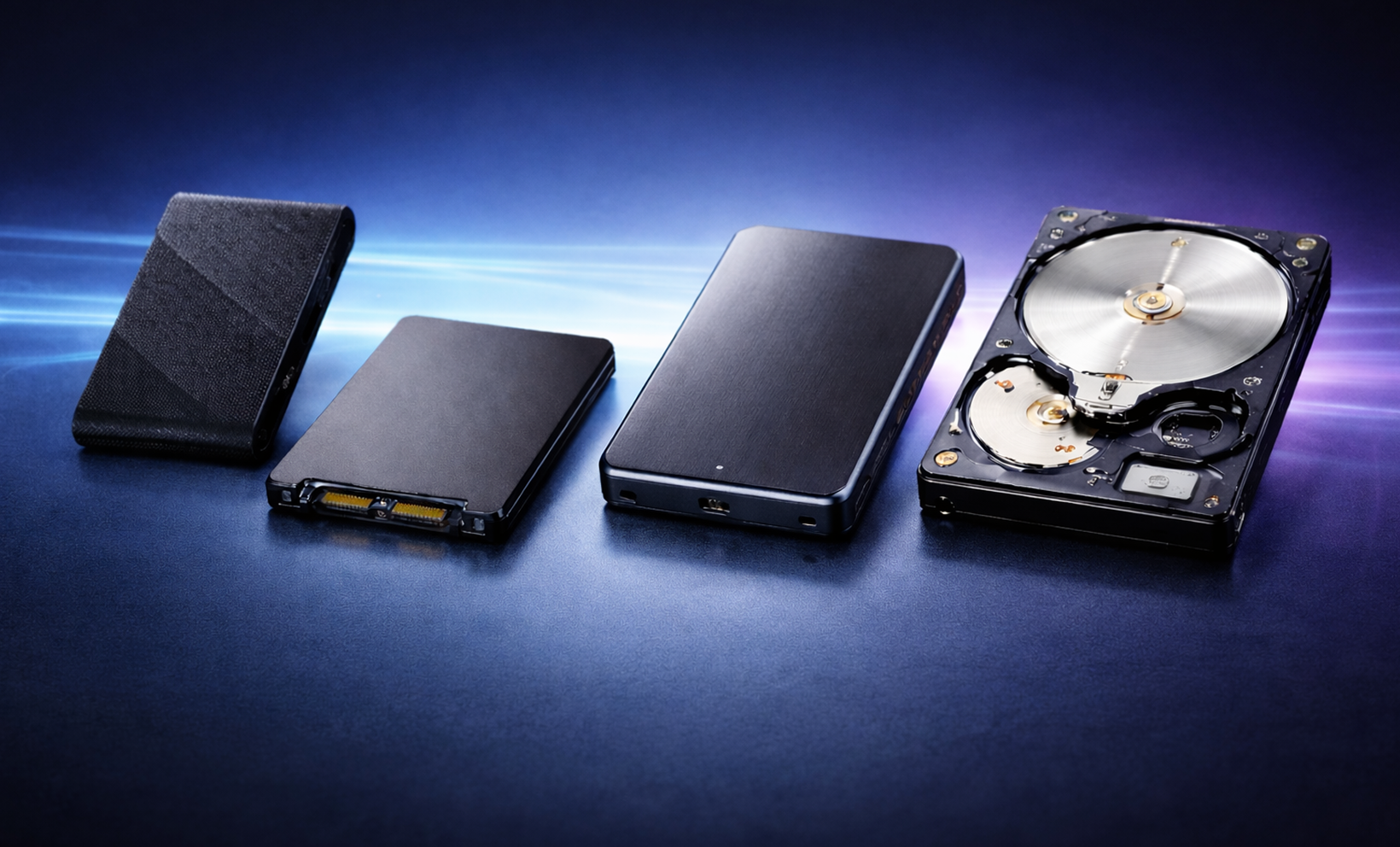
Gaming performance is no longer limited to your GPU and CPU. The storage drive you choose has a significant impact on load times, game performance, and overall gaming experience. If you’re looking for the best SSD for gaming, you’ve come to the right spot. Direct macro will help you grasp the distinctions between storage technologies and select the ideal SSD for your gaming setup. How? Because we provide a wide choice of the best SSDs for gaming, including PCIe 5.0, 4.0, 3.0, and SATA SSDs. We also provide high-quality HDDs to ensure optimal performance and speed. Let’s take a look at how SSD technology will improve in 2026 for gaming.
Understanding SSD Technology for Gaming
Solid state drives have transformed gaming by removing the mechanical restrictions of traditional hard drives. Unlike HDDs, which use spinning platters and moving read/write heads, SSDs store data in flash memory, resulting in significantly quicker read and write rates. This leads to speedier game installations, smoother open-world gameplay experiences, and shorter load times.
PCIe 5.0 vs 4.0 vs 3.0: Breaking Down the Generations
When looking for the best SSD for gaming systems, you may come across many PCIe generations. It is critical to grasp the differences between them before making any new purchases.
1. PCIe 5.0: The Cutting Edge
PCIe 5.0 represents the most recent innovation in storage technology. It has theoretical rates of up to 14,000 MB/s for reading and 12,000 MB/s for writing. The top PCIe 5.0 SSD alternatives on the market are pushing these limits, bringing amazing performance to gamers.
However, the real-world gaming advantages of PCIe 5.0 are currently negligible when compared to PCIe 4.0. Most games are not designed to take full use of these high speeds. The best PCIe 5 SSD for gaming may be future-proofing your system, but you’ll pay a premium for technology that gaming has yet to completely adopt.
2. PCIe 4.0: The Sweet Spot
For most gamers, PCIe 4.0 strikes the ideal balance between performance and value. PCIe 4.0 SSDs provide outstanding gaming performance without the high cost of PCIe 5.0, with read and write speeds of up to 7,000 MB/s and 5,000 MB/s respectively.
The PCIe 5.0 vs 4.0 debate frequently boils down to pragmatic requirements against future-proofing. Current games run nearly identically on both technologies, making PCIe 4.0 the more cost-effective option for gaming-oriented systems.
3. PCIe 3.0: Still Relevant
Despite being an older generation, PCIe 3.0 SSDs are still fantastic for gaming. With read speeds of around 3,500 MB/s and write speeds of 3,000 MB/s, they are still much quicker than SATA SSDs and more than suitable for modern gaming requirements.
In real-world gaming circumstances, the performance differences between PCIe 5.0, 4.0, and 3.0 are surprisingly modest. A game that takes 8 seconds to load on PCIe 5.0 may take 10 seconds on PCIe 3.0, which most players will not notice during gameplay.
SATA vs HDD: Legacy Technologies Still Have Their Place
While NVMe drives dominate performance discussions, SATA SSDs and HDDs remain relevant for budget-conscious gamers. Understanding their strengths helps build balanced storage solutions without overspending on unnecessary speed.
SATA SSDs: Affordable Solid-State Performance
The best SATA SSD for gaming offers a significant upgrade over traditional hard drives without requiring the latest motherboard technology. SATA SSDs typically deliver speeds around 550 MB/s, which is substantially slower than NVMe drives but still provides excellent gaming performance.
For budget-conscious gamers or those with older systems, the best SATA SSD for gaming represents an affordable entry into solid-state storage. Games installed on SATA SSDs load considerably faster than HDDs, and the overall system responsiveness improves dramatically.
HDDs: Budget Storage for Game Libraries
The SATA vs HDD comparison clearly shows that SATA SSDs are superior for gaming performance. However, hard disk drives continue to act as secondary storage for big game collections. HDDs, which have capacities of 8TB or more and are reasonably priced, are great for keeping games you don’t play often.
Many gamers take a hybrid strategy, using a fast NVMe SSD for their operating system and presently played games and a big HDD for their entire game collection.
Capacity Considerations: Finding Your Sweet Spot
Modern games are becoming more demanding in terms of storage space. Call of Duty games can need up to 200GB of space, while Red Dead Redemption 2 requires more than 150GB. Capacity is therefore an important factor to consider when selecting the best SSD for gaming.
1TB: Minimum Recommended
While 1TB SSDs are less expensive, they fill up quickly with modern games. If your budget only allows for a 1TB drive, consider pairing it with a larger secondary drive for additional capacity.
The 2TB Standard
The best 2TB SSD for gaming is now the recommended capacity for serious gamers. This size accommodates your operating system, vital programs, and 15-20 contemporary AAA games without requiring regular shuffling. The 2TB sweet spot provides good value per gigabyte while assuring that you do not run out of space during a gaming marathon.
4TB and Beyond
For gamers and content creators, 4TB drives completely eliminate storage worry. However, the price increase for this capacity is enormous, making it unsuitable for pure gaming setups.
External Storage Solutions for Gaming Laptops
Gaming laptop customers have distinct storage difficulties. Internal upgrading possibilities are frequently restricted, making external solutions appealing. But which external SSD is ideal for gaming?
To ensure optimal performance, the ideal external SSD for gaming laptop setups should include USB 3.2 Gen 2×2 or Thunderbolt connectivity. These ports can reach speeds comparable to internal SATA SSDs, making them suitable for running games directly from external storage.
When choosing an external drive, consider portability, durability, and cooling capabilities. Gaming laptops benefit from compact, robust SSDs that can withstand the heat produced by prolonged gaming sessions.
SSD Comparison: Real-World Gaming Performance
Let’s look at how different SSD types perform in real-world gaming scenarios using an SSD comparison based on realistic metrics:
Game Load Times (Cyberpunk 2077)
- PCIe 5.0: 6.2 seconds
- PCIe 4.0: 6.8 seconds
- PCIe 3.0: 8.1 seconds
- SATA SSD: 12.3 seconds
- HDD: 45.8 seconds
Level Streaming (Spider-Man Remastered)
- PCIe 5.0: Seamless
- PCIe 4.0: Seamless
- PCIe 3.0: Minor stutters
- SATA SSD: Occasional stutters
- HDD: Frequent stutters
These findings show that, while faster drives improve experience, switching from HDD to any SSD delivers the most substantial increase.
Direct Storage and Future Gaming Technologies
Microsoft’s Direct Storage technology marks a significant shift in how games load assets. This capacity, included in Windows 11, allows games to load assets directly from your SSD to your GPU, avoiding CPU decompression constraints.
Direct Storage-optimized games will benefit the most from speedier SSDs, particularly NVMe drives. This technology makes picking a future-proof SSD more critical for gamers who intend to retain their computers for several years.
Thermal Management and Endurance
High-performing SSDs generate a lot of heat, which might reduce performance during long gaming sessions. Look for drives with integrated heatsinks or consider adding aftermarket cooling solutions, particularly for PCIe 4.0 and 5.0 drives.
Endurance ratings, given in TBW (Terabytes Written), show how much data can be written to the disk before it fails. For gaming, this is less important than for professional workloads, but greater endurance ratings provide piece of mind.
Making Your Decision: What to Buy
For most gamers, a 2TB PCIe 4.0 NVMe SSD provides the best balance of performance, capacity, and price. This arrangement performs admirably in current games while leaving room for future releases.
Budget-conscious builders can save money by using PCIe 3.0 drives or the best SATA SSD for gaming, both of which provide excellent real-world performance. The saved money might be used to upgrade the GPU or add extra RAM.
Enthusiasts seeking absolute maximum performance should look into the finest PCIe 5.0 SSD alternatives, keeping in mind that they’re paying a premium for incremental increases that future games may need.
Top 4 Best SSD for Gaming Products
1. Samsung 990 PRO 2TB PCIe 4.0 NVMe SSD

Samsung 990 PRO 2TB premium gaming SSD has remarkable 7,450 MB/s speeds and industry-leading stability. Ideal for enthusiasts looking for superior performance, advanced heat management, and Samsung’s renowned quality, as well as a thorough five-year guarantee.
Specifications
- Interface: PCIe 4.0 x4, NVMe 2.0
- Sequential Read: 7,450 MB/s
- Sequential Write: 6,900 MB/s
- Form Factor: M.2 2280
- NAND Type: Samsung V-NAND 3-bit MLC
- TBW Rating: 1,200 TB
- Warranty: 3 years (from manufacturer)
Reasons to Buy
- Exceptional performance consistency across all file sizes and workloads.
- Industry-leading reliability with Samsung’s proven track record and thermal management.
- Excellent value for premium performance with comprehensive warranty coverage.
Reasons to Avoid
- Slightly more expensive than comparable competitors in the same performance tier.
- Requires motherboard with PCIe 4.0 support for optimal performance gains.
- Heatsink version adds cost and may not fit all laptop configurations.
2. WD Black SN850X 2TB PCIe 4.0 NVMe SSD

WD Black SN850X gaming-optimized SSD has Game Mode 2.0 technology to provide consistent performance throughout marathon sessions. With speeds of 7,300 MB/s, this drive provides exceptional value for mainstream gamers while maintaining competitive pricing and dependable performance.
Specifications
- Interface: PCIe 4.0 x4, NVMe 1.4
- Sequential Read: 7,300 MB/s
- Sequential Write: 6,600 MB/s
- Form Factor: M.2 2280
- NAND Type: BiCS5 TLC
- TBW Rating: 1,200 TB
- Warranty: 3 years (from manufacturer)
Reasons to Buy
- Optimized specifically for gaming with game mode 2.0 for sustained performance.
- Competitive pricing makes it accessible for mainstream gaming builds.
- Excellent thermal performance with available heatsink model for PlayStation 5 compatibility.
Reasons to Avoid
- Slightly lower peak speeds compared to Samsung’s flagship offerings.
- Power consumption is higher than some competitors during intensive operations.
- Firmware updates occasionally required for optimal compatibility with newer systems.
3. Crucial P3 Plus 2TB PCIe 4.0 NVMe SSD

Budget-friendly PCIe 4.0 performance matches practical gaming requirements. The Crucial P3 Plus offers 5,000 MB/s speeds while consuming less power, making it ideal for budget-conscious gamers and laptop users looking for reliable performance without paying a premium.
Specifications
- Interface: PCIe 4.0 x4, NVMe 1.4
- Sequential Read: 5,000 MB/s
- Sequential Write: 4,200 MB/s
- Form Factor: M.2 2280
- NAND Type: Micron 3D QLC NAND
- TBW Rating: 440 TB
- Warranty: 3 years (from manufacturer)
Reasons to Buy
- Budget-friendly option that delivers PCIe 4.0 speeds at competitive prices.
- Lower power consumption makes it ideal for laptops and compact builds.
- Adequate performance for gaming without paying premium for marginal gains.
Reasons to Avoid
- QLC NAND technology offers lower endurance ratings compared to TLC alternatives.
- Write speeds decrease noticeably when SLC cache is exhausted during large transfers.
- Not ideal for heavy content creation workloads beyond gaming applications.
4. Samsung T9 Portable 2TB External SSD

The Samsung T9 portable 2TB external SSD offers fast USB 3.2 Gen 2×2 connectivity and speeds up to 2,000 MB/s. It is a great choice for gaming laptop users, console gamers, and anyone who needs reliable, high-performance storage in a tough, shock-resistant case.
Specifications
- Interface: USB 3.2 Gen 2×2 (20Gbps)
- Sequential Read: 2,000 MB/s
- Sequential Write: 2,000 MB/s
- Capacity: 2TB
- Durability: 3-meter drop resistant
- Compatibility: Windows, Mac, Android, PlayStation, Xbox
- Warranty: 5 years
Reasons to Buy
- This device is easy to carry, well-built, and small enough to fit in your wallet.
- It works smoothly with many devices, including gaming consoles and phones.
- Industry-leading speeds for external storage make it viable for running games directly.
Reasons to Avoid
- These drives cost more than internal SSDs that offer similar performance.
- To get the fastest speeds, you need a USB 3.2 Gen 2×2 port. Older ports will slow down performance.
- External drives tend to get hotter than internal ones during long gaming sessions.
Final Thoughts
Choosing the best SSD for gaming is determined by your specific needs, budget, and system configuration. While the most recent PCIe 5.0 technology has outstanding performance, PCIe 4.0 drives offer the best value for current gaming requirements. The best 2TB SSD for gaming reaches the sweet spot for capacity, although SATA SSDs are still viable for low-cost builds or older PCs.
Remember that SSDs outperform regular HDDs in terms of gaming performance. Whether you choose with the greatest PCIe 5.0 SSD, a mid-range PCIe 4.0 drive, or the best SATA SSD for gaming, you’ll see dramatically faster load times and increased gaming performance. When making your final pick, keep your budget, motherboard compatibility, and gaming habits in mind, and don’t underestimate the value of capacity planning for your growing game library.
We are a reliable gaming SSDs seller committed to providing premium storage solutions at competitive prices. For more information and detail call us at (855) 483-7810 or book your order today and save 5% by choosing our bulk order form.
Frequently Asked Questions
What is the best SSD for gaming?
The Samsung 990 PRO or WD Black SN850X represent the best SSD for gaming, offering PCIe 4.0 speeds, 2TB capacity, and excellent reliability. These drives balance performance, endurance, and value for serious gamers.
Which external SSD is best for gaming?
The Samsung T9 or SanDisk Extreme PRO are the best external SSD options for gaming, featuring USB 3.2 Gen 2×2 connectivity with speeds up to 2,000 MB/s, durable construction, and portable designs perfect for laptops.
Is PCIe 5.0 worth it for gaming?
PCIe 5.0 currently offers minimal gaming benefits over PCIe 4.0, with load time differences under one second in most games. Save money with PCIe 4.0 unless future-proofing for Direct Storage games is priority.
How much SSD storage do I need for gaming?
A two-terabyte SSD is optimal for modern gaming, as it can accommodate approximately 15 to 20 AAA titles. A one-terabyte SSD is suitable for budget systems but may reach capacity quickly. When determining storage requirements, account for average game sizes ranging from 50 to 150 GB.
Does SSD speed affect gaming FPS?
SSD speed does not directly affect frame rates during gameplay. However, faster SSDs can reduce stuttering in open-world games, minimize texture pop-in, and significantly decrease level loading times, thereby enhancing the overall gaming experience and immersion.
Categories


tags

Expert team support
We accept POs from fortune 1000 companies, government agencies, defense, schools and hospitals.
Do you need advice on buying or selling hardware? Fill out the form and we will return.

Sales & Support
(855) 483-7810
We respond within 48 hours on all weekdays
Opening hours
Monday to thursday: 08.30-16.30
Friday: 08.30-15.30



